Why You Keep Getting Hurt: The Truth About Training Load and Injuries
Most of us have the relationship between training and injury backwards.
The assumption is that harder training means more risk. So the smart move is to stay conservative. Same weights, same routine, same comfortable intensity. And when you do get hurt, the lesson seems obvious, you overdid it.
But think about when people actually get hurt. It's almost never in the middle of a well-established routine. It's helping a friend move. It's the pickup game you play once a month. It's jumping back into training after three weeks off and picking up where you left off. The activity always gets blamed. What rarely gets examined is the months of insufficient preparation that preceded it.
The Science of Training Load: Tissue Capacity vs. Familiarity
Researcher Tim Gabbett spent years tracking training loads and injury rates across rugby league, cricket, soccer, and Australian football. The general finding challenges the "be careful" narrative. Athletes who spiked their training loads, big jumps relative to what they'd been doing, got hurt more often, this makes sense. However, athletes who had been consistently training at high loads over weeks and months had fewer injuries than athletes at low or moderate loads. More importantly Under-trained athletes got hurt at rates comparable to the ones who overdid it.
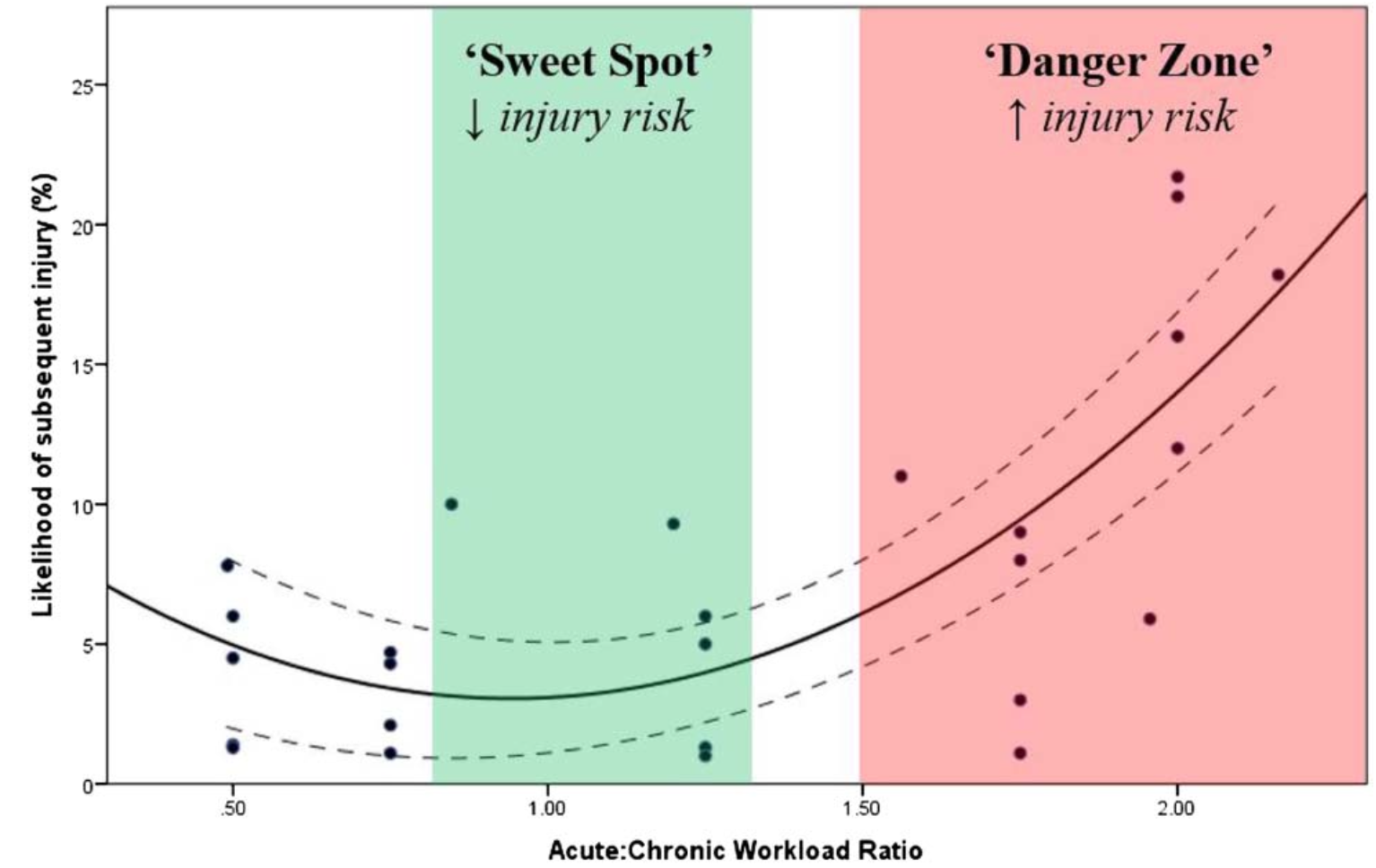
The relationship is a U-shape. Both ends are dangerous. The protective zone is in the middle, and it's higher than most people assume.
While Gabbett's specific framework isn’t perfect and I wouldn't treat specific percentage thresholds as guidelines. The directional finding holds up: spikes in load relative to what you've been doing are where injuries happen, and a consistently higher base is protective.
This isn't just an athlete problem. Think about how most of us live. Desk for 40 hours+, then weekend warrior mode. Same manageable weights for months, then yard work that asks for something completely different. Three weeks off because life got busy, then Monday at full intensity. Every one of those is the same spike pattern, an acute demand that jumped past what the body was prepared for.
Part of this is tissue capacity. Your muscles, tendons, ligaments, and bones adapt to loads you consistently place on them. Bone remodels under stress. Tendons strengthen with progressive load. All of it takes time and consistency, but it's well-established physiology.
What Pain Science Tells Us About Protective Responses
There's another layer worth mentioning. Pain science, Butler, Moseley, and others offer a model where the nervous system evaluates demands against what it's been exposed to recently. Unfamiliar loads can trigger protective responses; pain, guarding, altered motor output, even when the demand is within your structural capacity. Not every protective response works this way, but the model fits something I see constantly: people getting hurt doing things their tissues can handle, because their nervous system hadn't seen that demand recently enough to treat it as routine. Consistent training, in this view, isn't just building tissue tolerance. It's building familiarity.
What that means in practice is worth paying attention to. The next time you tweak your back helping someone move, or your knee flares up the first week back from vacation, pay attention to what you blame. The instinct will be to blame the activity. The box was too heavy, you shouldn't have run that far, you went too hard. And the conclusion that follows will feel responsible: take it easy. Be more careful. Avoid the thing that hurt you.
But if the research tells us anything, it's that the moment of injury is usually the wrong place to look. The better question is: what did the last six weeks look like? Were you building toward that demand, or did it show up cold? Was this a spike, or was it within the range of what your body had been doing?
That distinction changes what you do next. "I overdid it" leads to avoidance. "I wasn't prepared for it" leads to preparation. One makes your world smaller. The other makes your body more capable.
Most people don't need to train less carefully. They need to train more consistently and they need to understand that consistency isn't the cautious choice. It's the thing that actually makes you hard to break.