Why Your Neck Pain Sticks Around
The Science of Joint Position Error
Neck pain can be frustratingly complex. It often isn't just about a tight muscle or a "stuck" joint, but rather a failure of the body's data feedback loop.
Every time you move, your brain relies on proprioception—a continuous stream of data telling it where your head is in space. However, factors like old injuries, chronic pain, or fatigue can corrupt this data. When the feedback loop is disrupted, your brain has a decreased ability to predict movement accurately. This can lead to protective guarding, stiffness, and a cycle of dysfunction that lasts months instead of days.
At Optimize Chiropractic, we don't guess about these deficits; we measure them. Our primary tool for quantifying this "awareness gap" is the Joint Position Error (JPE) Test.
The JPE Test: Measuring the Deficit
The JPE Test is a straightforward but powerful way to evaluate cervical proprioception.
How it works: You sit 90 cm from a target with a laser pointer attached to your head. You rotate your neck to look over your shoulder and then attempt to return exactly to the center with your eyes closed.
Why it matters: If you cannot return to neutral accurately, it indicates a failure in the sensorimotor control feedback loop. This lets us know that the issue is a layer deeper than just a sore neck. In fact, individuals with neck pain have significantly poorer joint position sense than healthy individuals. If we don't identify and correct this error, something many standard treatments overlook, the care will likely fail to provide lasting relief.
The Empty Bucket of Rocks Effect: A Real-World Analogy
Years ago, I was helping my mother, an art teacher, move supplies. I went to lift a bucket that I assumed was packed with heavy river rocks. My brain predicted the weight and prepared my muscles for a heavy lift. However, the bucket was mostly bubble wrap with only a thin layer of stones. Because my prediction was wrong, I flew backward, nearly falling.
The same mechanism happens in your neck. If your proprioceptive data is wrong, your muscles may fire too hard, too late, or not at all. This results in uneven motion, persistent tightness, pain during routine movements like checking a blind spot, or even dizziness.
The Neurology of the Neck & Its Relationship to Pain
If the JPE test measures the "glitch" in your navigation system, it is important to understand what that glitch can impact.
Your body relies on a complex network of reflexes to keep you upright, stable, and focused. These reflexes don't operate in a vacuum; they rely on accurate data from multiple sensors throughout the tissues of the neck.
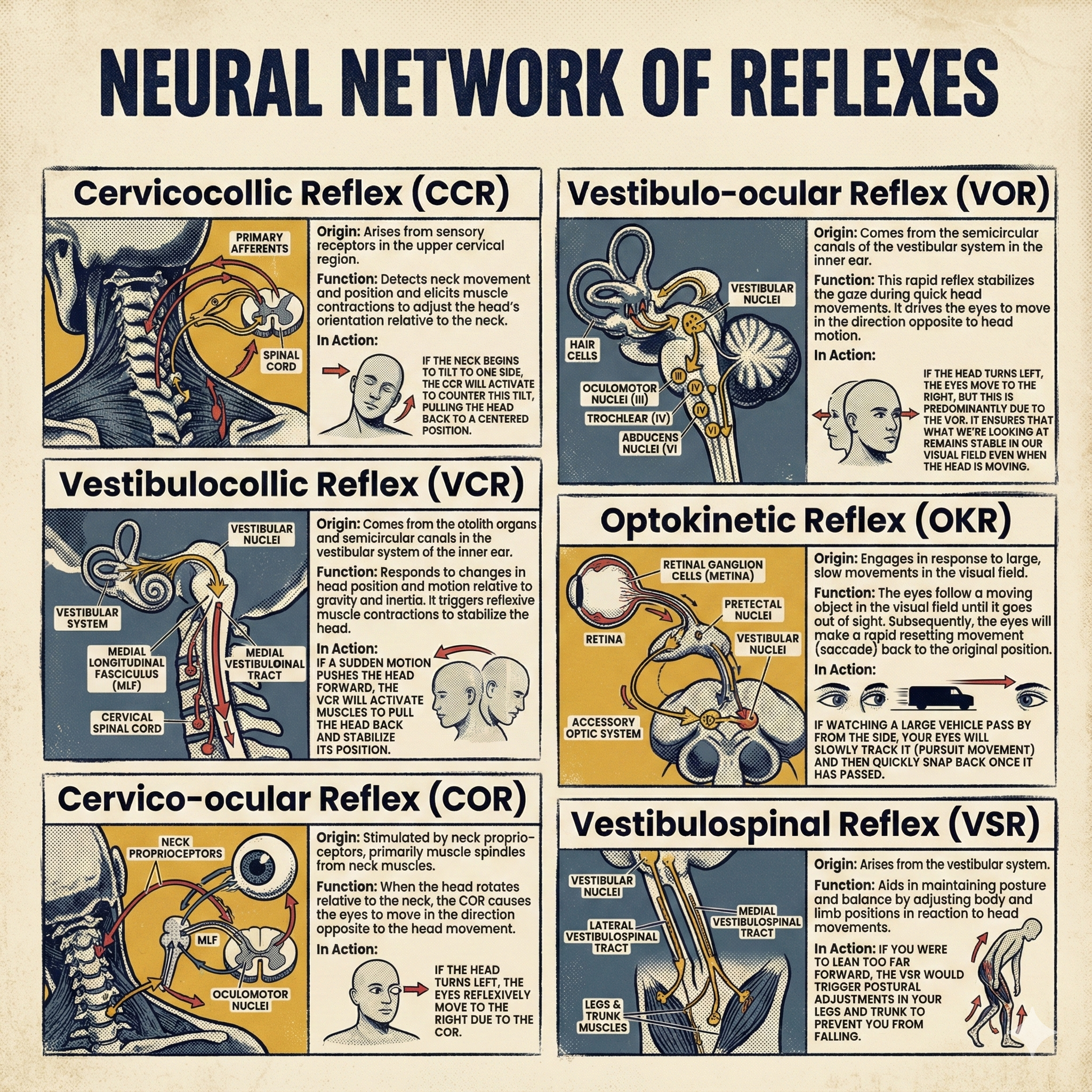
When neck position sense is altered, it doesn't necessarily "break" these reflexes, but it creates a state of sensory mismatch. The brain receives conflicting reports—one from your eyes, one from your inner ear, and a different one from your neck.
Here is how faulty position sense shifts your brain to compensate, often resulting in stiffness, pain, dizziness, or fatigue.
1. The Stabilizers: Cervicocollic (CCR) & Vestibulocollic (VCR) Reflexes These reflexes act as your body's autopilot for head position.
The Role: The CCR uses neck sensors to stabilize head movement, while the VCR uses the inner ear to keep the head level against gravity.
The Conflict: When the neck provides "noisy" or inaccurate data, the CCR loop becomes inefficient. The brain, sensing instability, often compensates by increasing muscle tone.
The Result: This is why your neck feels perpetually tight or "guarded." It isn't just a cramp; it’s a functional strategy your brain uses to create artificial stability because it can't trust the sensors.
2. The Visual Links: Cervico-Ocular (COR) & Vestibulo-Ocular (VOR) Reflexes Have you ever had trouble focusing on a screen or felt dizzy turning your head quickly? It likely involves the interplay between these two reflexes.
The Role: The VOR is your primary eye stabilizer during movement, keeping your vision clear while your head turns. The COR assists this process using input from neck muscles.
The Conflict: In a healthy system, the VOR does most of the work. However, research suggests that when neck pain is present, the brain "turns up the volume" (gain) on the COR to compensate for the lack of reliable data.
The Result: You become hyper-reliant on a neck reflex that is already providing bad data. This contributes to eye fatigue, difficulty tracking moving objects, and that "floating" sensation often described by patients with chronic neck issues.
3. The Whole-Body Connection: Vestibulospinal Reflex (VSR) Your neck acts as a steering wheel for your entire posture.
The Role: The VSR adjusts the muscles in your torso and legs to prevent you from falling. It relies on the neck to know how the head is oriented relative to the body.
The Conflict: If your JPE is faulty, the VSR may misinterpret a head turn for a body turn.
The Result: This can lead to subtle unsteadiness while walking, bumping into door frames, or a general sense of disequilibrium.
Ideally, all these inputs; vision, vestibular, and proprioception agree. However, when your Joint Position Sense is off, the brain is forced to manage a constant disagreement between these systems. This mental "multitasking" drains energy and leads to the brain fog and fatigue often associated with chronic neck pain.
By working to re-establish proper communication, we aren't just relaxing muscles; we are resolving the conflict so these reflexes can return to their normal, energy-efficient state.
A Data-Driven Approach to Dysfunction
While the JPE is critical, we look at the full data set to comprehensively understand your neck pain. We utilize a suite of diagnostic tools to evaluate every layer of dysfunction:
Range of Motion: Evaluating movement symmetry and restriction.
Modified Clinical Test of Sensory Interaction on Balance (mCTSIB): A in-depth look at how the balance system is performing.
Limits of Stability: Measuring your functional base of support, which is often reduced in those with pain.
Cervical Challenge Test: Examining postural sway across different head positions to rule out vestibular (inner ear) issues.
The Solution: Re-Calibrating the System
When it comes to finding long-term relief from chronic neck pain, more than just Chiropractic is needed. We need an active way to help restabilize the connection between the brain and the neck. We use a combined approach to restore this feedback loop:
Assessment: We identify the specific "blind spots" in your movement using the JPE and other tests listed above, as well as an assortment of specific orthopedic tests.
Structural Correction: We use specific adjustments to alleviate tension and restore normal joint motion.
Retraining: We implement targeted exercises to improve the function of the neck muscles.
By combining structural care with sensorimotor retraining, we don't just treat the pain; we fix the navigation system that causes it.
If you or someone you know has been struggling with neck pain and has yet to find a solution, that’s why we’re here: to dig a layer deeper, to understand the picture more clearly, and to help you get the results you deserve so you can go back to living your life fully.
Click below to schedule your complimentary consultation and find out how we can help you.